

Artificial Intelligence in Education Market Growing at 43.3% CAGR Through 2032
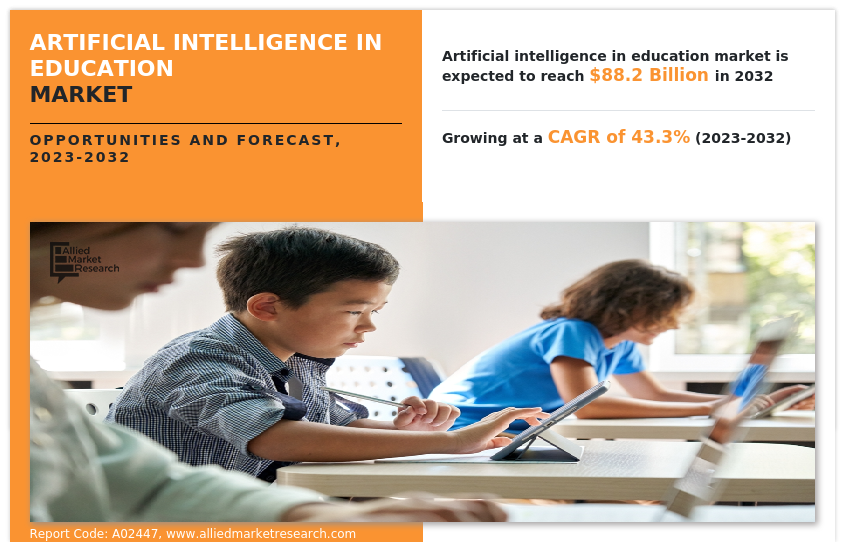
AI in education market is projected to reach $88.2 billion by 2032 driven by smart learning tools.
Rising demand for personalized and remote learning boosts AI in education market growth globally. ”
WILMINGTON, DE, UNITED STATES, May 28, 2026 /EINPresswire.com/ -- — Allied Market Research
According to a report published by Allied Market Research, the artificial intelligence in education market size was valued at $2.5 billion in 2022 and is projected to reach $88.2 billion by 2032, registering a CAGR of 43.3% from 2023 to 2032. The rapid integration of advanced technologies such as artificial intelligence, machine learning, deep learning, and natural language processing into educational systems is transforming the global learning landscape.
Download PDF Brochure: https://www.alliedmarketresearch.com/request-sample/2782
The artificial intelligence in education market is witnessing significant growth due to the increasing demand for personalized learning experiences, intelligent tutoring systems, virtual facilitators, and AI-powered educational platforms. Educational institutions, corporate learning providers, and digital education companies are increasingly investing in AI-driven solutions to improve learning outcomes, automate administrative processes, and deliver adaptive educational content.
Rising Role of Artificial Intelligence in Modern Education
Artificial intelligence is reshaping traditional education systems by introducing intelligent learning environments that improve teaching efficiency and student engagement. AI-powered tools can analyze learning patterns, identify weaknesses, and provide customized educational content tailored to individual student needs.
From K-12 schools to higher education institutions and corporate training programs, educational organizations are adopting artificial intelligence technologies to create more interactive and effective learning experiences. Intelligent tutoring systems, automated grading solutions, virtual teaching assistants, and predictive analytics platforms are becoming essential components of modern education systems.
The increasing digitalization of education has created strong demand for advanced educational technologies that improve accessibility, flexibility, and learning efficiency. Artificial intelligence in education solutions enables institutions to automate repetitive administrative tasks, allowing educators to focus more on personalized instruction and student development.
Personalized Learning Driving Market Expansion
One of the major growth drivers of the artificial intelligence in education market is the rising demand for personalized learning experiences. Traditional teaching methods often struggle to address the diverse learning styles and abilities of students. AI technologies help bridge this gap by delivering customized educational content based on individual learning behaviors and performance data.
AI-powered learning platforms analyze student progress in real time and adjust course materials according to learning speed, comprehension levels, and subject understanding. This adaptive learning approach improves student engagement and helps learners achieve better academic outcomes.
Personalized learning also allows educational institutions to identify at-risk students early and provide targeted interventions to improve academic performance. The ability of AI systems to predict student outcomes and recommend personalized study plans is expected to continue driving market growth throughout the forecast period.
Growth of Intelligent Tutoring Systems
Intelligent tutoring systems are becoming increasingly popular within the artificial intelligence in education market. These AI-powered platforms simulate one-on-one tutoring experiences by providing interactive guidance, real-time feedback, and customized instruction.
Unlike traditional educational software, intelligent tutoring systems continuously learn from student interactions and modify instructional strategies accordingly. These systems can answer questions, explain concepts, evaluate performance, and provide recommendations for improvement.
Educational institutions are increasingly adopting intelligent tutoring technologies to improve student outcomes while reducing the workload on teachers and instructors. The growing acceptance of self-paced learning models and digital classrooms is further strengthening the demand for intelligent tutoring systems globally.
Expansion of Virtual Learning Platforms
Virtual learning platforms have emerged as a key application area within the artificial intelligence in education market. AI-powered virtual classrooms provide interactive learning experiences through automated content delivery, smart assessments, and virtual facilitators.
Educational organizations are leveraging AI technologies to create engaging online learning environments that replicate classroom interactions. Features such as automated attendance tracking, speech recognition, real-time translation, and personalized recommendations are enhancing virtual education experiences.
The increasing popularity of remote and hybrid learning models is expected to continue supporting the growth of AI-enabled virtual learning platforms. Educational institutions worldwide are investing heavily in digital learning infrastructure to meet evolving student expectations and improve accessibility.
Machine Learning and Deep Learning Transforming Education
Machine learning and deep learning technologies are playing a critical role in the growth of the artificial intelligence in education market. These technologies allow educational platforms to process large volumes of student data and generate actionable insights for educators and administrators.
Machine learning algorithms help identify learning trends, monitor student engagement, and predict academic outcomes. Deep learning models enhance educational experiences by supporting advanced capabilities such as speech recognition, language translation, and intelligent content recommendations.
AI-powered educational platforms can use machine learning to automate grading systems, reduce administrative burdens, and provide real-time analytics. These technologies improve operational efficiency while helping institutions deliver more effective and personalized learning experiences.
Cloud-Based AI Solutions Gaining Popularity
Cloud computing is becoming increasingly important in the artificial intelligence in education market. Cloud-based educational platforms offer scalability, remote accessibility, automatic software updates, and cost-effective deployment options.
Educational institutions are rapidly adopting cloud-based AI solutions to support remote learning, digital collaboration, and virtual classroom management. Cloud infrastructure enables organizations to store and process large volumes of educational data securely while supporting real-time access from multiple devices.
The cloud deployment segment is expected to witness the fastest growth during the forecast period due to its flexibility and operational efficiency. Educational organizations can easily scale cloud-based AI solutions according to changing enrollment levels and digital learning requirements.
Procure This Report (343 Pages PDF with Insights, Charts, Tables, and Figures): https://www.alliedmarketresearch.com/artificial-intelligence-in-education-sector-market/purchase-options
Impact of COVID-19 on AI in Education Market
The COVID-19 pandemic significantly accelerated the adoption of artificial intelligence technologies in education. The sudden transition to remote learning forced educational institutions worldwide to adopt digital learning platforms and virtual classroom technologies.
AI-powered educational solutions became essential tools for maintaining continuity in learning during lockdowns and school closures. Virtual classrooms, intelligent tutoring systems, automated assessments, and adaptive learning platforms helped institutions deliver quality education remotely.
The pandemic also increased awareness about the importance of personalized and flexible learning systems. Educational institutions recognized the value of AI technologies in supporting individualized learning experiences and improving student engagement in virtual environments.
As remote and hybrid learning models continue gaining popularity, the demand for artificial intelligence in education solutions is expected to remain strong in the coming years.
Benefits of AI for Educational Institutions
Artificial intelligence offers numerous advantages for educational institutions, educators, and students. AI technologies help automate administrative processes such as attendance management, scheduling, grading, and student communication.
Educational institutions can use predictive analytics tools to forecast enrollment trends, identify at-risk students, and optimize resource allocation. AI-powered chatbots and virtual assistants also improve communication between institutions and students by providing instant responses to queries.
For educators, AI technologies reduce repetitive workloads and allow more focus on teaching and student interaction. Students benefit from personalized learning experiences, real-time feedback, and improved access to educational resources.
These benefits are encouraging schools, universities, and corporate training providers to invest heavily in AI-driven educational technologies.
Challenges Limiting Market Growth
Despite rapid growth, the artificial intelligence in education market faces several challenges. One major concern is data privacy and cybersecurity. Educational platforms collect large volumes of sensitive student information, making them vulnerable to cyber threats and data breaches.
Institutions must implement strong security measures and comply with data protection regulations to maintain student trust and safeguard educational records.
Another challenge is the high implementation cost associated with AI technologies. Small educational institutions and organizations with limited budgets may struggle to invest in advanced AI infrastructure and software systems.
In addition, resistance to technological change and lack of digital literacy among educators can slow adoption rates. Proper training and support programs are essential to ensure successful integration of AI technologies into educational systems.
Regional Insights
North America dominated the artificial intelligence in education market in 2022 due to the strong presence of major technology companies and advanced digital infrastructure in the region. Educational institutions across the U.S. and Canada are actively investing in AI-powered learning platforms and virtual education technologies.
Companies such as Microsoft, IBM, Amazon Web Services, and Google are contributing significantly to the development of AI-driven educational solutions.
Asia-Pacific is expected to witness the highest growth during the forecast period due to rising internet penetration, increasing smartphone usage, and expanding digital education initiatives. Countries such as India, China, Japan, and South Korea are investing heavily in educational technology infrastructure and online learning platforms.
Government initiatives promoting digital education and smart classrooms are also expected to support market expansion in the region.
Segment Analysis
Based on component, the solutions segment accounted for the largest share of the artificial intelligence in education market in 2022. Educational institutions are increasingly adopting AI-powered platforms and software solutions to improve learning efficiency and streamline operations.
By deployment mode, the on-premise segment dominated the market due to advantages such as lower latency, enhanced customization, and faster processing capabilities. However, cloud-based solutions are projected to witness the fastest growth during the forecast period.
In terms of technology, the machine learning and deep learning segment held the largest market share in 2022. These technologies are widely used for predictive analytics, adaptive learning, and intelligent tutoring applications.
Based on application, learning platforms and virtual facilitators generated the highest revenue in 2022. Educational institutions are increasingly adopting AI-powered learning systems to improve digital education experiences and support remote learning environments.
By end user, the K-12 segment is expected to experience significant growth due to increasing adoption of smart learning tools and digital classrooms in primary and secondary education systems.
Competitive Landscape
Major companies operating in the artificial intelligence in education market are focusing on innovation, strategic partnerships, and product development to strengthen their market position. Key players include Microsoft Corporation, International Business Machines Corporation, Amazon Web Services, Google, Cognizant, DreamBox Learning, BridgeU, Carnegie Learning, Pearson, and Nuance Communications.
These companies are investing in AI research, machine learning technologies, cloud infrastructure, and personalized learning solutions to address the growing demand for intelligent educational platforms.
Get a Customized Research Report: https://www.alliedmarketresearch.com/request-for-customization/2782
Future Outlook
The future of the artificial intelligence in education market appears highly promising as educational institutions continue embracing digital transformation. AI technologies are expected to play an increasingly important role in delivering personalized, scalable, and accessible education worldwide.
Advancements in machine learning, natural language processing, and intelligent analytics will continue improving learning experiences and operational efficiency across educational institutions. The increasing adoption of remote learning, smart classrooms, and adaptive learning platforms is expected to create substantial opportunities for market growth over the next decade.
Trending Reports in Energy and Power Industry:
Artificial Intelligence in Education Market
https://www.alliedmarketresearch.com/artificial-intelligence-in-education-sector-market
Oil and Gas Data Management market
https://www.alliedmarketresearch.com/oil-and-gas-data-management-market
Asia-Pacific Smart Building market
https://www.alliedmarketresearch.com/asia-pacific-smart-building-market-A14204
Physical security market
https://www.alliedmarketresearch.com/physical-security-market
Threat Intelligence Market
https://www.alliedmarketresearch.com/threat-intelligence-market
North America Family/Indoor Entertainment Centers Market
https://www.alliedmarketresearch.com/north-america-family-entertainment-centers-market-A05970
About Us
Allied Market Research (AMR) is a full-service market research and business-consulting wing of Allied Analytics LLP based in Portland, Oregon. Allied Market Research provides global enterprises as well as medium and small businesses with unmatched quality of "Market Research Reports" and "Business Intelligence Solutions." AMR has a targeted view to provide business insights and consulting to assist its clients to make strategic business decisions and achieve sustainable growth in their respective market domain.
Pawan Kumar, the CEO of Allied Market Research, is leading the organization toward providing high-quality data and insights. We are in professional corporate relations with various companies and this helps us in digging out market data that helps us generate accurate research data tables and confirms utmost accuracy in our market forecasting. Each and every data presented in the reports published by us is extracted through primary interviews with top officials from leading companies of domain concerned. Our secondary data procurement methodology includes deep online and offline research and discussion with knowledgeable professionals and analysts in the industry.
David Correa
Allied Market Research
+ + + + + + + + + + + + +1 800-792-5285
email us here
Visit us on social media:
LinkedIn
Facebook
YouTube
X
Legal Disclaimer:
EIN Presswire provides this news content "as is" without warranty of any kind. We do not accept any responsibility or liability for the accuracy, content, images, videos, licenses, completeness, legality, or reliability of the information contained in this article. If you have any complaints or copyright issues related to this article, kindly contact the author above.
